



Building a privacy-first server-side tracking and attribution platform for modern e-commerce
Trackity is a server-side tracking and attribution platform built for Shopify and WooCommerce businesses. It helps e-commerce teams recover lost conversion data, understand the complete customer journey, and make better advertising decisions through accurate, first-party data.
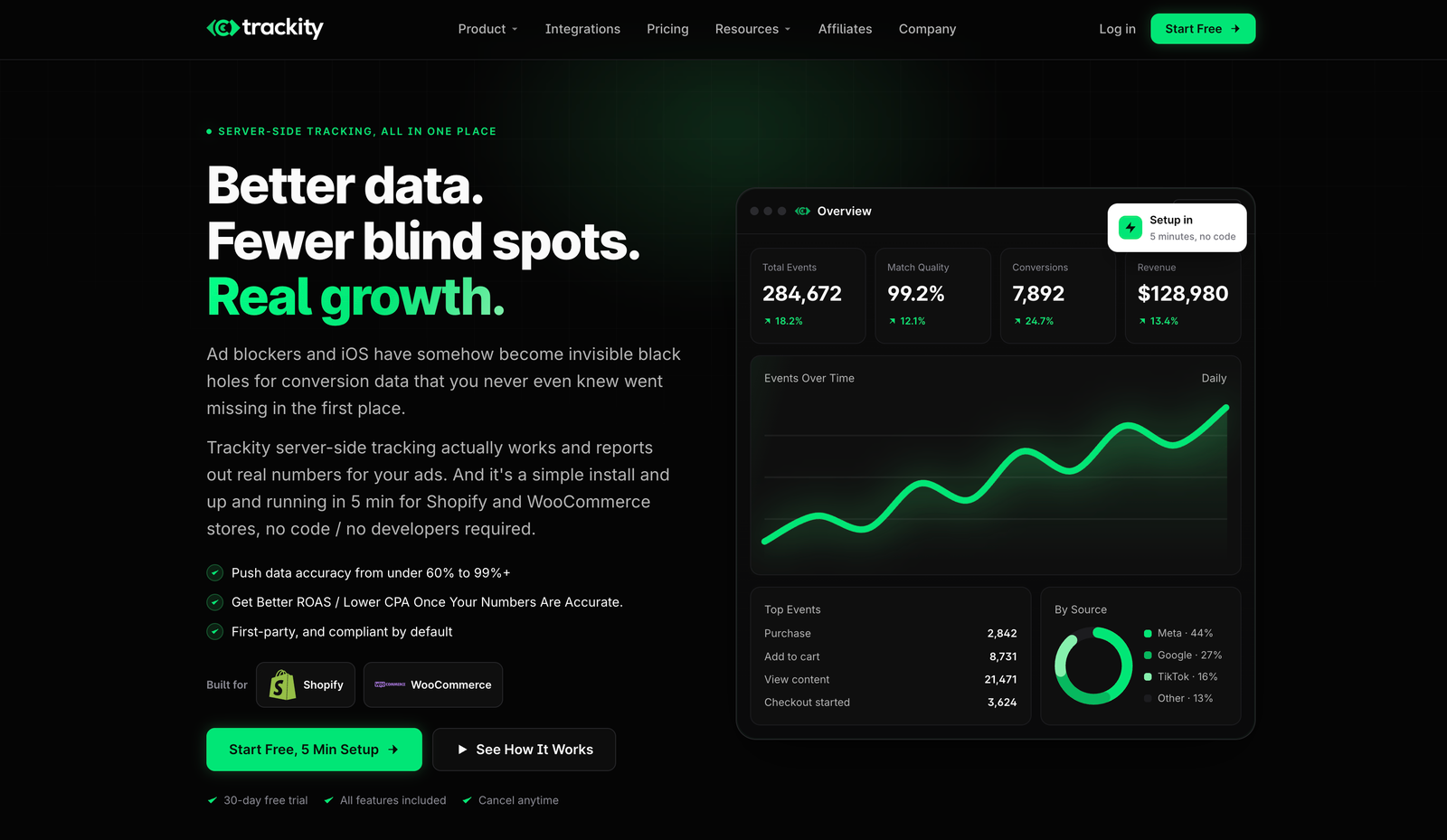
E-commerce businesses were making decisions with incomplete data.
Modern advertising depends heavily on accurate conversion data. But browser-based tracking is increasingly affected by ad blockers, iOS privacy restrictions, cookie limitations, and inconsistent tracking across platforms.
As a result, businesses can lose visibility into significant portions of their customer journeys and conversions. Different platforms can report different numbers for the same business, making it difficult to understand which campaigns and channels are actually driving revenue.
Trackity was created to solve this problem.
The goal was to build a platform that could capture customer and conversion events through both client-side and server-side tracking, reconcile those events into a single source of truth, and deliver reliable data back to the advertising and analytics platforms businesses already use.
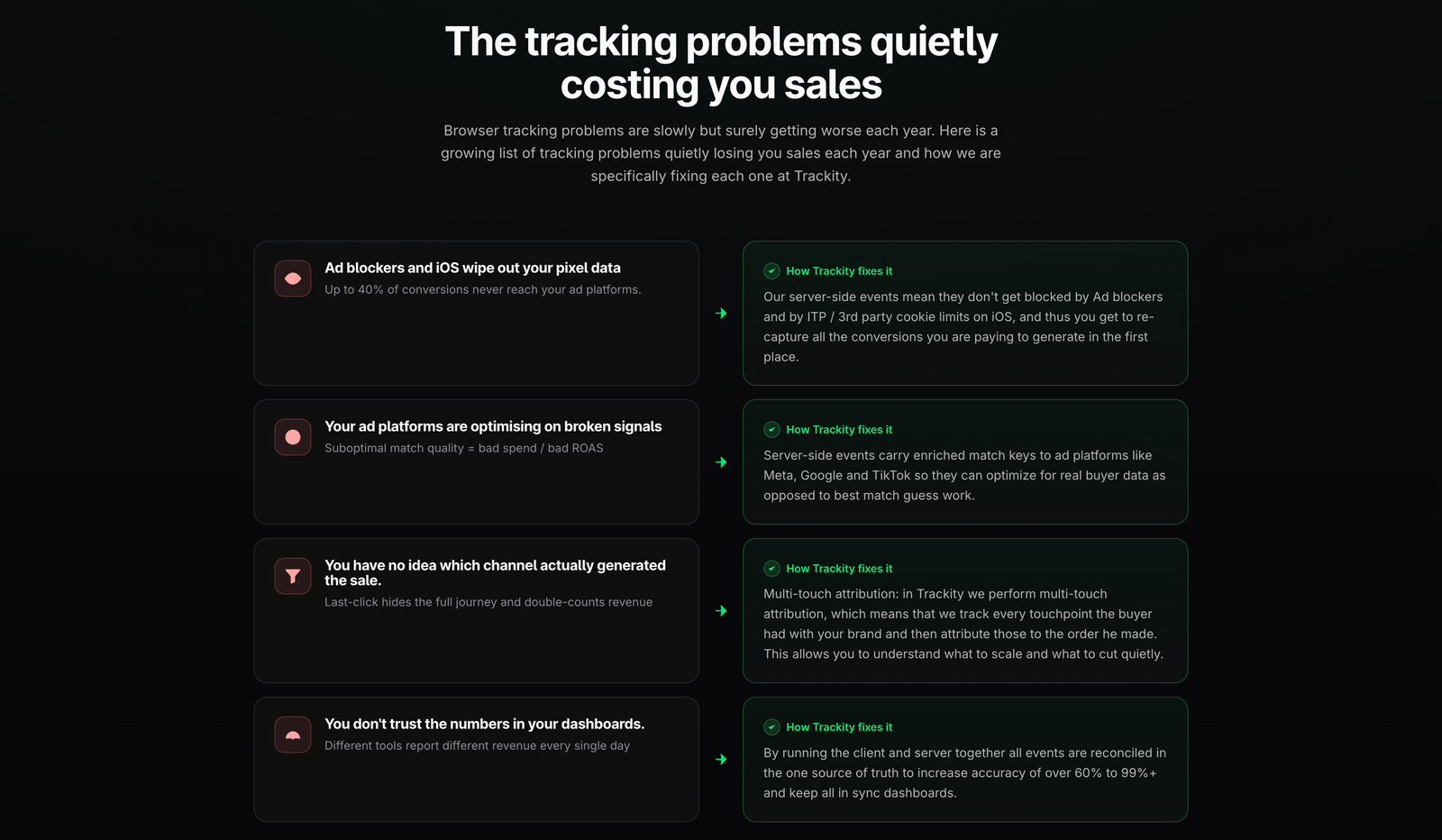
Building the tracking infrastructure, not just another analytics dashboard.
We approached Trackity as a complete product engineering challenge. The platform needed to combine a simple, no-code onboarding experience with sophisticated event collection, attribution, data processing, integrations, analytics, and infrastructure capable of operating in real time.
Our work covered the entire product, from the user-facing application and dashboard to the underlying tracking and processing infrastructure.
The result is a dual-layer tracking architecture that combines lightweight browser-side tracking with server-side conversion tracking. Events from both layers are reconciled into a single de-duplicated source of truth.
One platform for tracking, attribution, and growth analytics.
Trackity gives e-commerce teams a centralized view of their marketing and customer data. Users can connect their Shopify or WooCommerce store, connect their advertising channels, and begin collecting and analyzing events without manually configuring complex tracking infrastructure.
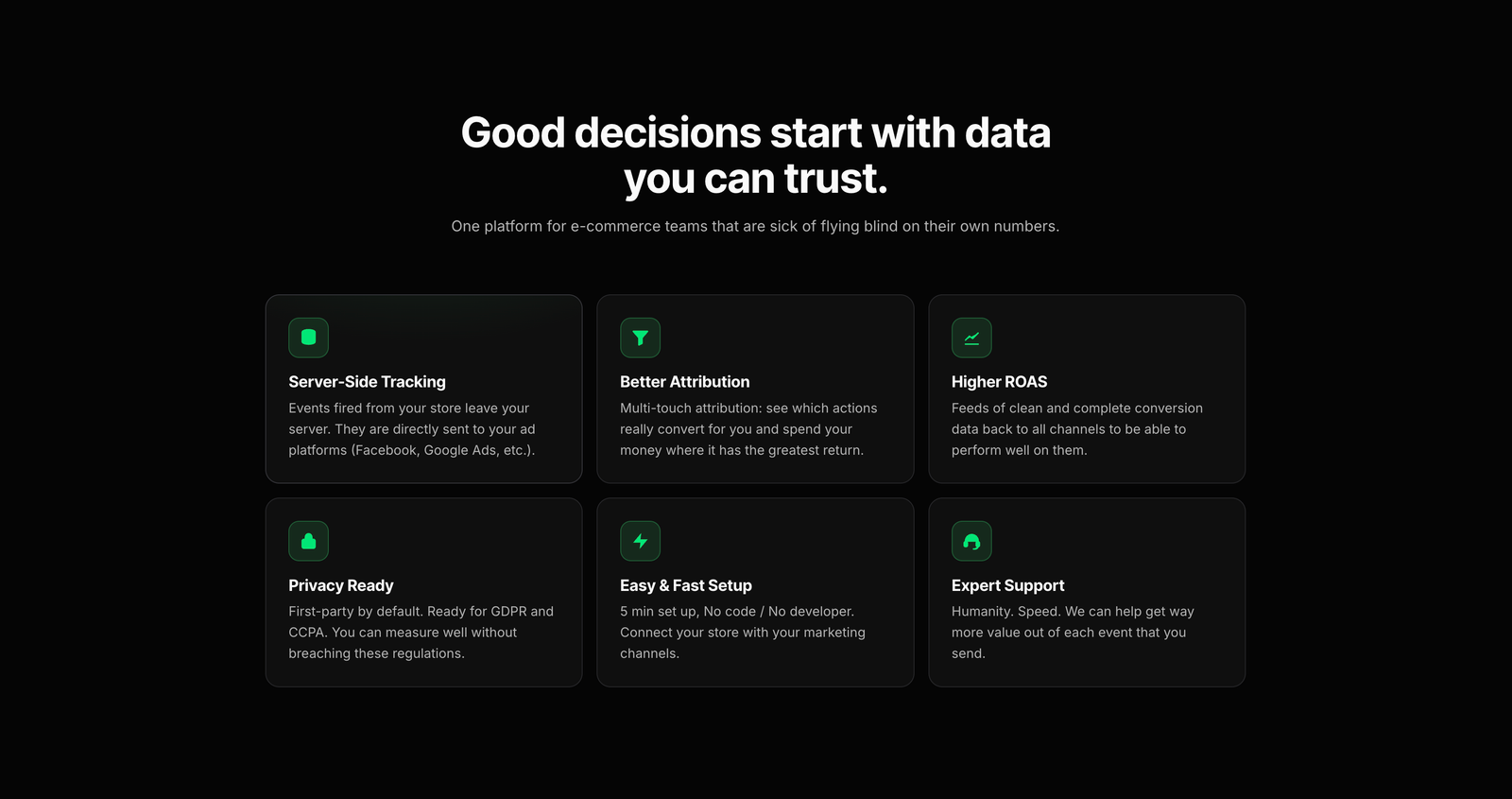
Capturing the events browsers miss.
At the heart of Trackity is its dual-layer tracking architecture. A lightweight asynchronous JavaScript SDK captures events in the browser, while server-side infrastructure captures conversion data independently.
This provides a fallback when browser-based tracking is interrupted by ad blockers, privacy restrictions, or network conditions.
The two layers are reconciled to prevent duplicate events while maintaining a single source of truth.
From the first interaction to the final purchase.
Trackity automatically captures key customer interactions throughout the purchasing journey. Instead of looking at an isolated conversion, businesses can follow the path from initial interaction through page views, add-to-cart events, checkout activity, and purchase.
This gives marketing teams a more complete understanding of how customers interact with their brand before converting.
Giving every marketing channel the context it deserves.
Last-click attribution can hide the interactions that happen before a purchase. Trackity allows teams to switch between multiple attribution models and evaluate the contribution of different channels across the customer journey.
Single-Touch Attribution
Multi-Touch Attribution
This allows businesses to compare marketing channels from different perspectives instead of relying on a single attribution model.
Turning raw tracking data into decisions.
Trackity transforms the collected data into a centralized reporting environment where businesses can monitor marketing performance in real time.
The dashboard brings together advertising spend, impressions, clicks, CPC, CPM, conversions, revenue, ROAS, and ROI across connected channels.
ROAS
Understand return across channels and campaigns.
ROI
Connect advertising performance to actual business outcomes.
Profit & Loss
Move beyond advertising metrics and understand profitability.
Channel Overlap
See how different marketing channels contribute to the same journey.
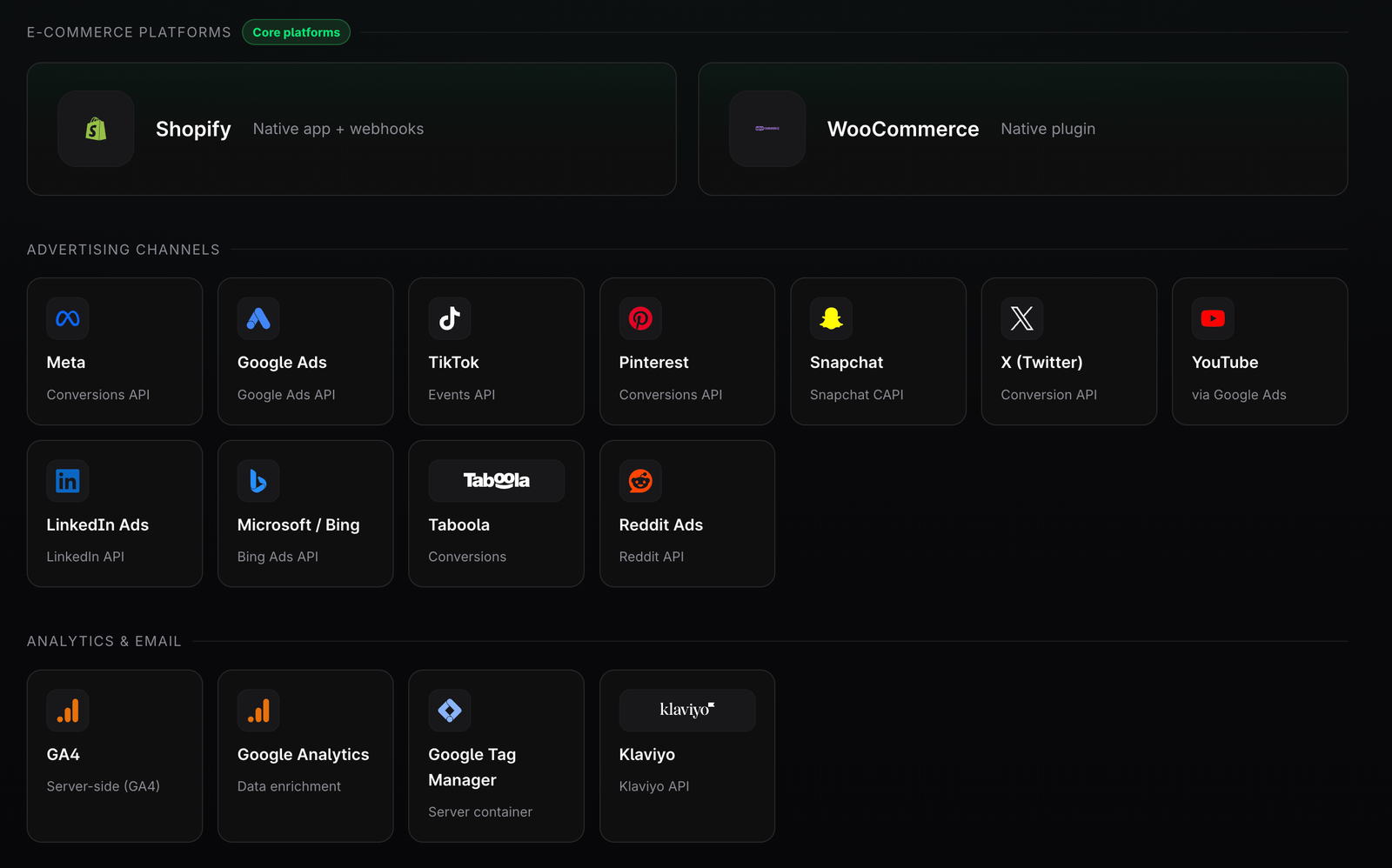
Connecting the marketing stack businesses already use.
Trackity was designed to work alongside the platforms e-commerce businesses already depend on. The platform supports direct server-side connections with major advertising and analytics platforms, and connects directly with Shopify and WooCommerce as the underlying commerce platforms.
These integrations allow Trackity to collect, process, and distribute clean conversion data without forcing businesses to replace their existing marketing stack.
Three ways Trackity goes beyond basic tracking.
Turning first-party data into better audiences.
Trackity also uses its first-party tracking layer to help businesses build higher-quality audiences for remarketing and lookalike campaigns.
Moving from reporting to proactive intelligence.
Beyond reporting historical performance, Trackity incorporates predictive analytics and anomaly detection to help businesses identify changes in behavior and emerging trends.
One platform that scales with the business.
Trackity supports multi-store accounts, team management, role-based access, and fine-grained permissions, making it suitable for businesses and agencies managing multiple properties.
Built for accuracy, speed, and resilience.
One of the biggest challenges was creating infrastructure that could process high volumes of tracking events in real time without compromising reliability.
CORE STACK
The cloud-native stack behind Trackity.
Resilience was built into the architecture. Trackity uses multiple mechanisms to keep data flowing even when individual tracking methods fail:
Data accuracy shouldn't come at the expense of privacy.
Because Trackity handles sensitive customer and marketing data, security and privacy were treated as core product requirements rather than an afterthought.
First-party tracking
AES-256 encryption in transit and at rest
GDPR and CCPA-ready data handling
Mandatory two-factor authentication
Automated backups
Live infrastructure monitoring
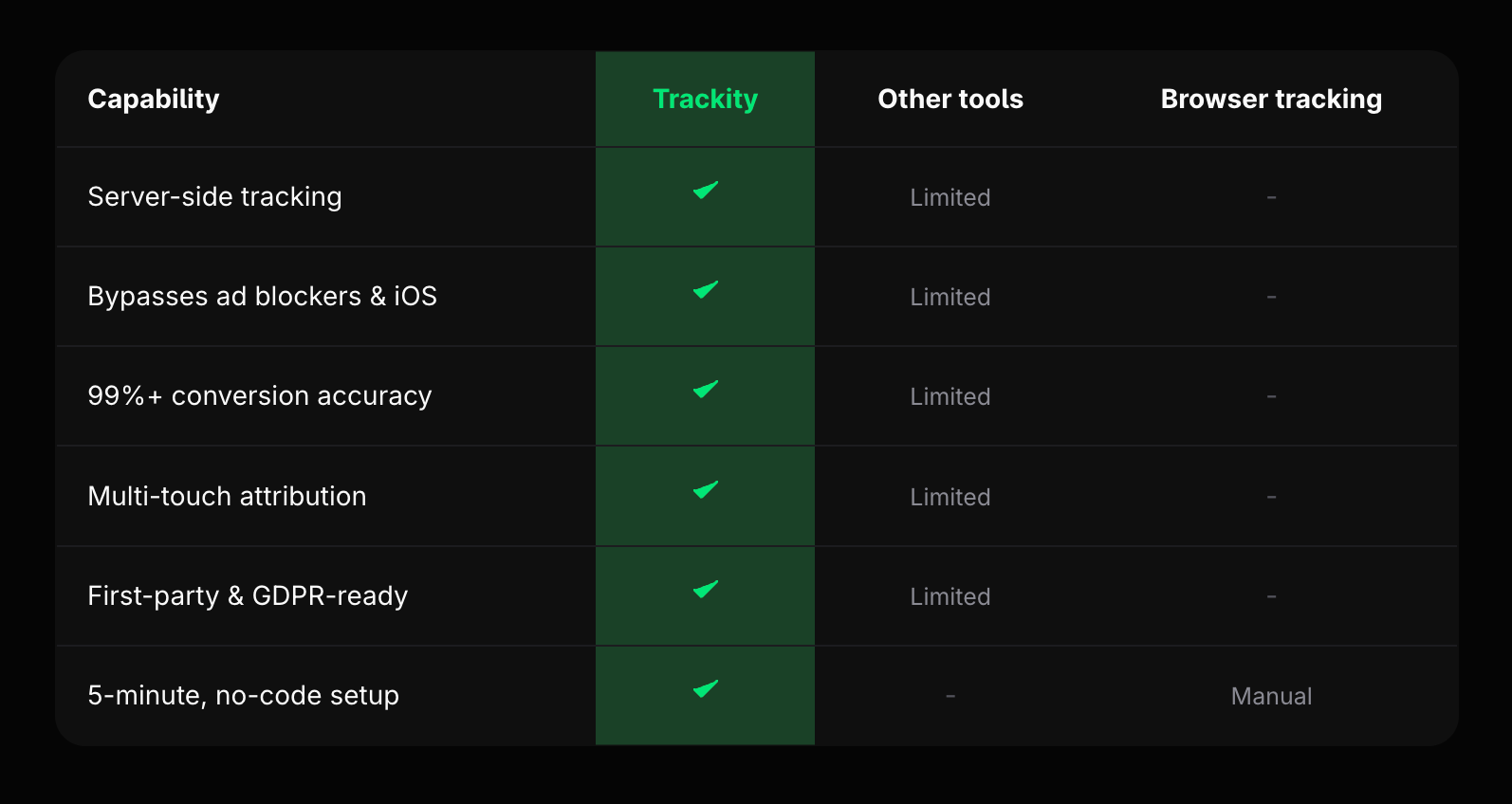
Built to outperform both legacy tools and raw browser tracking.
Trackity combines multi-layer event collection, server-side infrastructure, attribution, integrations, and merchant-facing reporting in one connected platform.
A complete tracking infrastructure for modern e-commerce.
We built Trackity as an end-to-end product, from the customer-facing experience to the tracking infrastructure and integrations operating behind it.
“The complexity of Trackity lives underneath the product. For the end user, the experience is intentionally simple: connect a store, connect marketing channels, and start tracking.”
That balance, sophisticated infrastructure underneath a straightforward product experience, was one of the central principles behind our work on Trackity.

Haysam quote hereHaysam Bin Tahir Cofounder & CEO, Prodgrade
Trackity represents our work across the full product development lifecycle. From product engineering and application development to tracking infrastructure, third-party integrations, data processing, analytics, and cloud infrastructure, Prodgrade built the platform end-to-end.
The result is a production-grade SaaS product designed to solve one of the increasingly difficult problems in e-commerce: knowing whether your marketing data can actually be trusted.
Have a project in mind? Let's build something worth a case study.
Tell us what you're working on. We'll get back to you within one business day.